Hi everyone – thanks to @krst for kicking-off this discussion. We agree that the DAO needs a lighter-weight path for housekeeping upgrades like token-gateway listings, fee-receiver tweaks, or metadata corrections.
Here’s our proposed solution to help empower more nimble, competent decision making for maintenance related upgrades, yet have the DAO retain oversight and veto capabilities on changes proposed.
Summary of proposed solution:
-
Create an Optimistic Maintenance Council (5 seat technical council consisting of Offchain Labs, the Arbitrum Foundation, 2 whitelisted security auditors, and a DAO elected technical representative).
-
Proposal authors will have the first week of every month to submit their intent of creating an optimistic proposal. All submissions must follow the standardized template provided by the Arbitrum Foundation. Proposal authors will also need to post a reply to a dedicated forum post to inform the DAO about their intent.
-
The council will use the next 2 weeks to do due diligence on the proposed changes. This includes (not limited to) template completeness, audit hash, proposer legitimacy, and calldata correctness.
-
If the due diligence stage passes, the council will proceed to create the proposal, and at least 3 out of 5 council members will need to vote FOR to progress the proposal to the veto stage.
-
The DAO will have a 7 day veto period to cast their veto votes. For a proposal to be successfully vetoed, a veto quorum (proposed to be 3% of votable supply) AND majority must be achieved. If both conditions are met, the proposal is canceled.
-
If either of the veto conditions are not met at the end of the veto period, the proposal will be optimistically passed, and will be executed.
Optimistic Maintenance Council
Tally proposes the DAO create an Optimistic Maintenance Council to balance technical expertise and independence, while staying nimble enough to keep the maintenance pipeline moving.

Quorum & Voting Rule
-
3 of 5 seats are required to vote FOR to advance a maintenance proposal to the veto stage.
-
Any seat may abstain, but abstentions count as not contributing to quorum; i.e., at least three explicit FOR votes are mandatory.
Conflict-of-Interest Safeguards
-
Council members must disclose any token ownership or service contracts with the proposer.
-
If an auditor has a material conflict (e.g., auditing the same team for another engagement), that seat must recuse in the vote stage and publicly disclose this on the forum thread.
-
Offchain Labs and the Arbitrum Foundation should not accept payments for their seats on the council.
Proposed Process
The proposed process runs for 4 weeks. Proposal authors should only have the first week of each month to submit their intent to create a proposal using the optimistic governance path. Any submissions that fall outside of the first week will be reviewed the following month by the council.
-
Intent window (week 1): Proposal author submits intent using the Foundation-supplied maintenance template on a dedicated forum thread.
-
Due-diligence by Council (weeks 2 and 3): Council confirms template completeness, audit hash, proposer legitimacy, and calldata correctness. Council members discloses COI if relevant.
-
Council vote & on-chain creation (week 3): Proposal is posted to Tally; ≥ 3 of 5 council members must vote FOR within 24 h to advance.

-
Optimistic veto (week 4): Seven-day Snapshot where any ARB holder may vote AGAINST. The proposal is blocked only if:
-
a majority (> 50 %) of votes are AGAINST, and
-
veto turnout (decided by the DAO. Tally proposes for it to be 3% of votable supply, which is representative of a voter majority).
-
-
Execution: If the veto fails, the queued transaction executes automatically. If the veto succeeds, the proposal is cancelled.
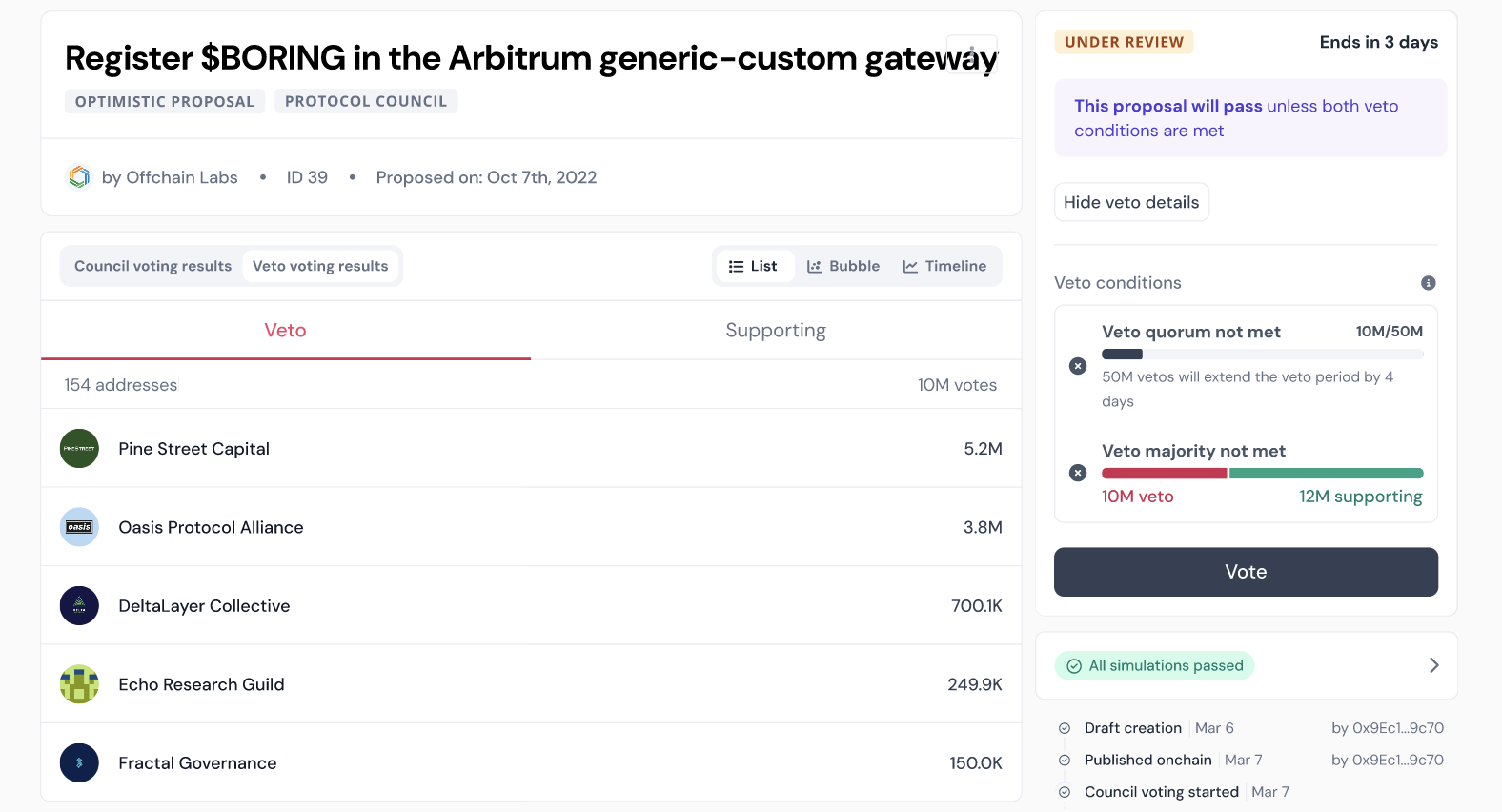


Screenshots of proposal optimistically passing and being executed ^

Screenshot 2025-08-05 at 2.38.16 AM1254×506 44.1 KB
Screenshots of proposal being veto-ed ^
Video demo of end to end flow:
https://www.loom.com/share/4e8581479aa44d0a8d628f74e9ed18b0?sid=5d48ed02-92e9-4300-a0a0-32a041ac8e46
Built-in safeguards
-
Scope-limited: Proposals under the optimistic governor path must not include ArbOS upgrades, economic-parameter changes (eg: Timeboost updates), changes to the treasury governor, core governor, security council and elections contracts, and changes to the constitution.
-
Public audits required: Audit reports from whitelisted firms must be included in the template, and published in the forum post.
-
Full transparency: Tally UI surfaces these proposals as Maintenance – Optimistic, shows council signatures, and surfaces live veto tallies. (see demo)
-
Rotating seats – auditor and elected-delegate slots are refreshed annually via Snapshot to prevent ossification.
Benefits
-
Efficiency and Mitigation of Quorum Risk: Maintenance upgrades and token registrations on the custom gateway can be executed in a month, as opposed to going through the entire constitutional AIP governance lifecycle. Additionally, the risks of these constitutional proposals failing because of failure to achieve quorum is mitigated.
-
Delegate focus: Constitutional bandwidth is reserved for material protocol changes like ArbOS upgrades, changes to the core governor contracts, and improvements to the security council elections.
-
DAO Oversight and Veto Capabilities: Delegates can still block anything contentious.
Recommended next steps for the working group
-
Discuss feasibility and sentiment on Tally Optimistic Governance flow on governance calls.
-
Align on the exact veto quorum (3% is our recommendation).
-
Publish the forum template and the monthly “intent” calendar.
Tally is ready to contribute UI work, contract code, and process documentation. We look forward to collaborating with L2BEAT, Offchain Labs, the Arbitrum Foundation, and delegates to refine and ratify this track.