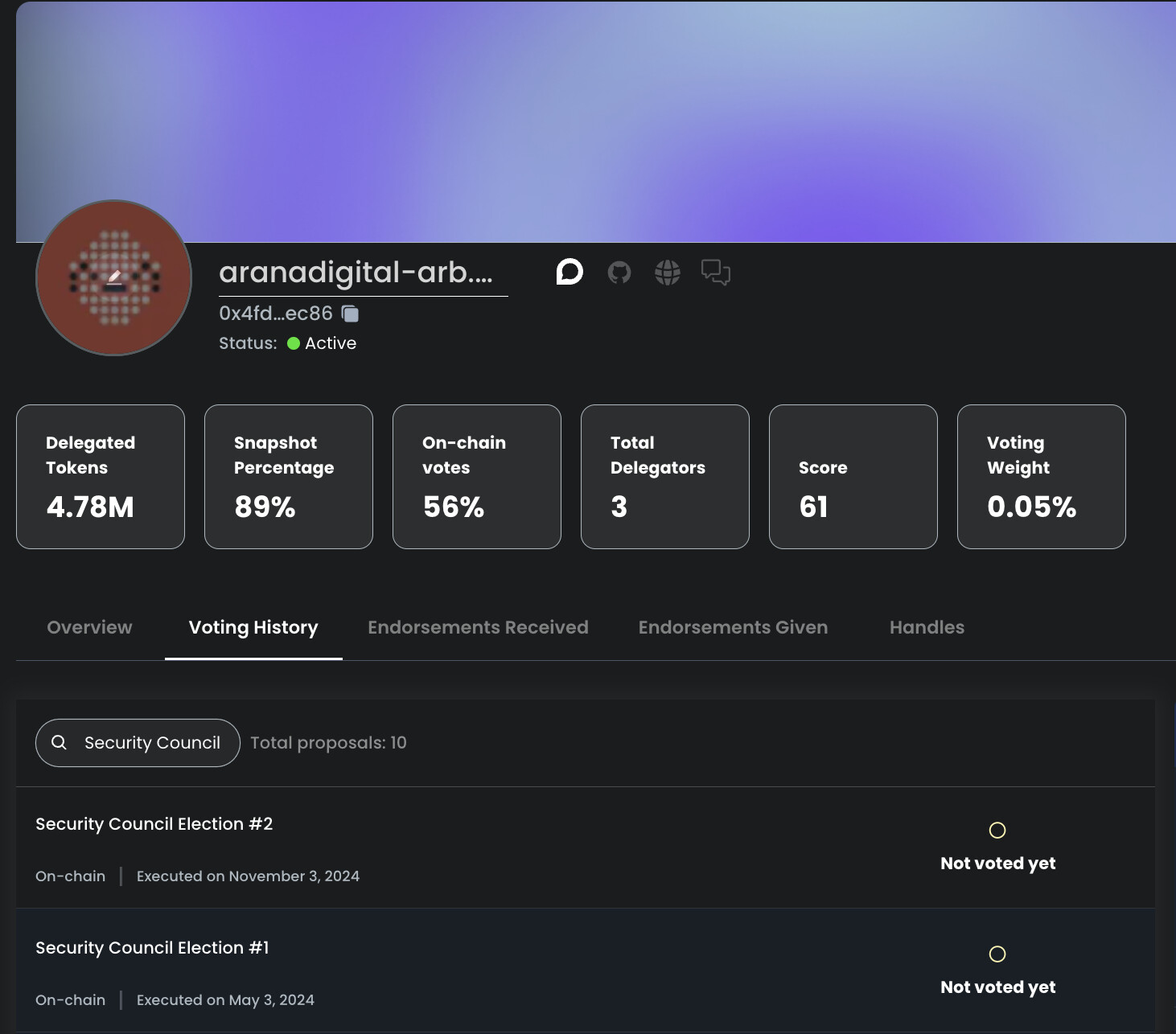
For this period, we received 12.5 out of 15 for our PR score. We believe our participation score may not reflect our prior engagement due to our recent requirement to migrate to a multisig wallet. Our previous wallet and voting records can be seen with our prior Karma Dashboard, and we have discussed the inclusion of this prior participation to our current scoring.
Please let us know if you need any additional materials or information, if there were other factors impacting our score, or how we can better ensure the inclusion with our PR rating.
It is unclear to me how the “parameter” timing is calculated.
I am one of the first to comment on all proposals, significantly before the voting starts, but I have almost the minimum score for this.
Last month the timing was 3.67, and now in the same situation it is 1.67. How is this calculated?
For example, how did you calculate this score for mixed on-chain voting, where comments were made more than six months ago? It is strange to calculate it by the Communication Rationale time, because this is commenting right after the voting.
How are bonus points for participating in community calls calculated? Last month, for example, I participated in the same number of calls, but received 4.37, and now only 2.
A similar question about Clarity & Communication, which talks about how clear and detailed my comments are.
I understand that this is a subjective parameter, but why is there such a difference from last month? Some formula has changed, I just want to understand.
Hi Paulo, appreciate the engagement and the opportunity to discuss this case transparently—looks like this is the first instance of a delegate’s compensation being formally challenged by another delegate!
To provide full context, my work on this initiative began in October 2024, focusing on defining and refining Arbitrum’s value proposition around interoperability. The goal was to strengthen the Orbit stack and position Arbitrum as a leader in this space.
This initiative was well received within the DAO and inspired Offchain Labs to allocate resources toward a broader project, which evolved into the Universal Intent Engine. The impact extended beyond Arbitrum, contributing to an Ethereum-wide initiative kickstarted by the Ethereum Foundation: the Open Intent Framework.
As part of the proposal, a list of projects already in production and well-suited to support chain abstraction was recommended. Everclear was included in this list due to its unique positioning in the stack, alongside several other projects. Importantly, Everclear was not designated as a mandatory partner but merely an available option for solvers: the most fair set up you can get. Everclear may receive access to a liquidity credit line (like the other protocols) but there was no commercial transaction.
Additionally, I recently concluded my collaboration with Everclear, meaning I do not receive direct compensation from any commercial agreements that may arise (beyond existing token holdings).
On Incentives and Precedents
The key question that should emerge from your challenge is: What kind of contributions should the DAO prioritize?
An ideal delegate doesn’t just comment on forum proposals—they identify strategic opportunities, develop initiatives that advance the ecosystem, engage key stakeholders, and drive tangible results. The work done here did exactly that.
My perspective is the opposite of yours: this is precisely the type of contribution the DAO should encourage.
If we do not recognize initiatives like this (try to generalize beyond this personal case), we risk setting a precedent where high-impact, proactive work is undervalued while lower-effort contributions are incentivized instead. The DAO benefits when delegates are empowered to launch meaningful initiatives that expand Arbitrum’s reach and capabilities.
So far, much of the DAO’s DIP focus has been on governance processes, but the next step should be fostering an entrepreneurial mindset—one that actively builds on Arbitrum and strengthens an ecosystem of aligned protocols.
Open to further discussion on refining the BP framework to ensure incentives remain aligned.
Thank you for replying and engaging with this @maxlomu since I think we should figure this out in the open, here on the forum.
My main point for that dispute was that I assumed that your work on that proposal was made as business development work for Everclear, not as an Arbitrum DAO delegate. Which by the way, if it was BD work for Everclear, it was very good work, because it had a successful outcome for Everclear by being included in the list of the official Offchain Labs announcement of the Interop program and, I assume, being part of the pilot that you announced.
So, to help clarify my assumptions, could you directly answer just a few questions:
Is Everclear part of that Offchain Labs pilot? In which capacity? (I asked you to clarify this in this comment on the proposal, as well).
Were you working as Ecosystem Lead for Everclear from October 2024 to the 19th of December 2024? (December 19th is the date of your last comment on the proposal, before your pilot announcement comment)
What specific contributions have you made to this proposal during the month of January? (I’m asking because there were no updates on the proposal forum thread in January 2025)
Would you say that your work on this proposal can be considered business development work for Everclear? If not, how so?
To clarify my position, I agree with this completely, even for this specific proposal, which I think is valuable for the DAO. But, if this proposal was made as business development work for Everclear, while you were the Ecosystem Lead for Everclear, I think there should not be any BP awarded to it because:
Now, we can argue if you being part of Everclear falls, or not, into this criterion of “do not have funds allocated to the creator (of the proposal)”, but it ultimately is a decision of the PM of the DIP, since BP is awarded completely at the discretion of @SEEDGov. So I’ll wait for their response to my dispute.
And yes, this is the first time a delegate has put up a DIP dispute regarding another delegate’s score. As I said in a DM to you, my aim with this dispute is to understand and clarify how the DIP works for everybody so that all delegates understand what can count, or not count, as BP, not to challenge your compensation as a delegate, or your contributions to the DAO.
In our records, both the deprecated wallet (0x0579A616689f7ed748dC07692A3F150D44b0CA09) and the new one (0x4fd86a688f36ada5d6b7eb76bb88e570c9deec86) have not participated in the last election for the Security Council (which ended on November 3, 2024; therefore, it is included in PR90).
As you can observe in the notes included in the individual reports of each delegate, the scores for the parameters Timing and Clarity & Communication are adjusted relative to Relevance, Depth of Analysis, and Impact on Decision-Making. This means that it is unlikely for the Timing score to be higher than the Relevance score, for example.
This is justified by the fact that a delegate may be the first to comment, but, if he/she provides low or medium-quality feedback, it makes no sense to assign the maximum Timing score to a comment that contributed little to the discussion. Timing is valuable when the comment is insightful or has a significant impact. The same applies to Clarity & Communication.
In summary, a comment may have the same or a lower score in these two parameters compared to the other criteria in the rubric. This will be better reflected in the February results when the Scoring system transitions to a 0 to 10 scale.
Remember that comments are analyzed only on a month-to-month basis; they do not depend on when a proposal goes to a vote, nor is there any relation to the CR.
The Bonus Points for participating in the calls are a percentage of the points you have earned during the month in the other parameters. This month, the maximum possible percentage was 2.5%, given that only 2 out of 4 scheduled calls took place.
Note: When comparing to December, it is important to remember that the maximum percentage for December was 7.5%, as 2.5% per call was assigned, a figure that decreased to 1.25% with update 1.51.
In both cases you’re right, we have forgotten to mark these comments as invalid for the DF.
Your score has been updated accordingly. Thanks for flagging!
Both CR correspond to votes on Snapshot (this becomes evident when observing that one comment was made on June 24 and the other on October 24).
It is worth noting that, although they later included the rationale in their last post on the Communication Thread, this was done on February 17, which was already past the deadline:
The proposal does not allocate funds to the creator.
There is no commercial transaction between OCL and Everclear.
The economic relationship between Everclear and @Maxlomu is beyond the scope of our analysis.
We do not believe there are grounds to change our stance regarding the BP awarded to Max.It is important to remember that what we aim to prevent is double-spending WITHIN the DAO.
It turns out that the rating indicated in the description from the site does not correspond to the actual calculation of points for timing?
On the site https://arbitrum.karmahq.xyz/ timing and claritу are different parameters
Do you consider it fair that the BP was awarded for the month of January since there was no comment on the original proposal in January?
I believe, if there was BP to be awarded for this work, it should have been in December, or maybe in February, because that’s when it was revealed that the proposal had a real impact, but not in January.
So what is the rationale for awarding this BP to @maxlomu in January?
The rationale is that it should have been in December, but since we did not know the final outcome of the proposal at that time, we decided to reflect this situation in the following month.
This week we were scheduled to pay the January comps as well as return the remaining funds from v1.0.
But, considering the drama with SAFE and also the potential reduced availability of MSS signers due to ETHDenver, we decided to pause payments until next week.
It is important to mention that while there are other existing UIs to replace SAFE (which is not available for Arbitrum multisigs right now), we avoid using them as we are not certain how familiar signers are with such solutions and we haven’t had the possibility to test them beforehand.
Please be aware that the DIP MSS holds more than 10M ARB right now, which is a substantial amount, so security should be always first in these cases.
We apologize for the inconvenience this may cause. We hope that you can understand it.